Pages

Monday, September 26, 2011

"Misi Jubah Merah"

Last Sunday, during the 2nd Fiqh Perubatan, I met Kak Long, one of our beloved senior who had just fly from Sabah to attend their Graduation ceremony the day before. Honestly, I’ve never seen kak Long in such high spirits before. Its like she have all the energy in the world, I can see the glow of happiness when she talked about the “jubah merah” and the graduation ceremony. Me and my best pal, Hayat took a picture, and I take the chance to ‘test’ the “jubah merah” myself. Its surprisingly comfortable by the way!


I had been reflecting quite a lot on that day. Not only because I get to meet Kak Long, but during Fiqh Perubatan itself, a lot of emotions takes place. If I can, I want the whole world to know about what I’m facing during my final year, and how much it had been affecting my studies. But what I fear the most is the kind of reaction I will get from others that will eventually affect my way of thinking in a negative way. I’m not making sense am I? Well, some things are not meant to be understood. But for once, wearing that “jubah merah” made me forget about all those troubles, and I really felt like ‘my turn’ to wear it for real is really that close. The feel of that heavy red fabric hugging my body feels warm and so welcoming. Will be it be next year for me? and next year is really just a couple of months away.

In my opinion, the happiness one felt during their graduation does not depend on their PNGK or wether they received distinction or what not. It depends on the overall performance of that particular student. How much effort had he or she put in making all of it worth it. And that is something only the person themselves can determined. Success is subjective isn’t? I always told myself that success to me is really that simple, its when I manage to be happy and always giving my best effort to gain the best in the worst of situations. It doesn’t matter how well I perform, as long as I give it my best, to me that is already considered as a success.

Looking at myself right now, thinking about all the ups and downs I went through, I really felt like I had been struggling real hard. Maybe others would beg to differ, and some might even criticize me, but no matter. I was told by my teachers, that “only you know how good you are, and don’t let anyone else let you feel down”. Heck yes! I’ve been doing my best to get myself in a good shape. Sometimes I failed, but I know sooner or later I will stand up anyway and walked in one piece or in pieces. I know that above all, I have to accept myself in order for me to be accepted by others. A good friend once told me, “the only person who will make your life easier is yourself”. How true she was, even though we sometime hope that the people around us will give us all the support we need to succeed, but in the end, all we have is ourselves to decide whether we want to stay on or give up. I felt really lucky being blessed to be on the road of tarbiyyah. The locus of support I’m receiving extends massively. Sometimes I can feel that the whole world is doing their part to help me, and InsyaAllah, only Allah alone will decide for me and His decision is the best decision.

Saturday, July 2, 2011

TIPS 8 : Internal Medicine in UKMMC

I was either very lucky or unlucky to have medicine as my first posting. Its been 3 weeks in internal medicine (IM). In my opinion, in IM there is not much variation of the things you need to do, but because medicine itself is a cocktail of all the basic things in medicine, the heaviness lies on the things you need to know, rather than the things you need to get done.The first week is the coffee and lectures week, where there will be lots of coffee to make sure you can stay awake for the long lectures. It might be a little too much to have lectures from 8am-5pm, but some of the lectures really got you thinking of how inadequate your knowledge is. So you will either become motivated to study even harder, or end up getting depressed or a mixture of both (most of the time), but then you need to stand up no matter what to get yourself ready for the real stuff.

My first ward work was at UKMMC. You either start at UKMMC, HKL or HTI. I don’t know about the rest yet, but here’s my very own tips to make sure you can stay, well at least, organized, during IM in UKMMC. Now IM in UKMMC is a lot heavier (from what I heard). It’s a compulsory to be present during ward rounds everyday and to present your case. So even though I say there is not much variation of the things you need to do, but covering the beds and preparing for the ward rounds sometimes takes up half of your life in medicine. Since there will be 4-5 person per ward, one person must cover 6-7 beds. What makes it more heavier is when you ward is very “active” despite being the “active ward” at all. Being in Medical 5, there will be 4-6 new cases every day, that’s right, EVERY DAY, and I don’t know about other ward rounds, our ward rounds will and always start at 9am and ends at 12pm, minimum. Oh yes, the second week is a good week for you to make sure your musculoskeletal system is up to the 3 hours round. So what should you keep in mind during IM? Here’s my tip

For new cases
  1. Arrive at the ward at 7am because most new cases came after midnight. You only have 1 hour then to clerk new case and do reviews. At 8.00am till 9.00am you have to attend either lectures, grand ward rounds, CME, or CPC. Right after the lecture finishes, you'll be expected to be ready for the rounds.
  2. Clerk the history and present in a way you are trying to arrive to a diagnosis, maybe not necessarily the full history. This is where you sell your stories to the specialist during rounds. Sometimes, there is not much time, so at least try to get the chief complaint and background history right. But come back later to try to get the full history too. Add up investigations and physical examination if you manage to do it in time.
  3. If patient could not give history (stroke patients, too tired, refuse, etc), no excuse, clerk the notes (last resort). At least you know your case. Spend time to clerk the case other times if possible.
  4. Don’t waste the presence of family members, catch them as soon as you see them, get the history from them too, not the other way around (refuse to take history because don’t want to disturb patients with their family member.)
  5. Get involve with the patient’s investigations, especially blood taking and branula. You will have the privileged to take the patient’s blood if he or she is your patient. But don’t get too greedy; make sure your friends get a chance to fill their log books too.

Follow up-ing patients / review patients

What to Review:

About yesterday:
  • Had the plan yesterday been carried out?
  • What was the result of the recent  investigations or procedures done to the patient? (In pertaining to the patient’s problem)
  • Who else had seen the patient yesterday? (Example: in referred cases/ physiotherapy/dietitian)

About today:
  • Is the patient well today? Any acute complaints?
  • What are the vitals? (BP, HR, RR, T, SpO2, etc..)
  • What are the physical findings today? (In pertaining to patient’s problem, eg: lungs clear, no more abdominal pain)
  • Is the patient plan for anything today?
  1. If possible, came at night to review your patients, at least get to know what happen to the patient yesterday. Usually too many new case to cover the next day, you have to give time for that in the morning. But almost every time, blood result will only be ready in the morning. So if you can come earlier than 7.00 am, you can get everything done quite magnificently good.
  2. If you have the time, help the HO to fill in the reviews so that you will not be questioned so much. Oh yes, don't forget to get really friendly with the HO. They gonna help you out quite a lot.
  3. To keep your reviews organized, make a table of the patient’s , vitals and important investigations so that you can update and see the trend of the result too. For example:
contoh..

So that’s all I can think of in terms of taking care of the ward and ward rounds. But there are other things to keep in mind during IM, the on calls, procedures to do, procedures to observe, lectures, teachings, oh, and of course the study groups. But basically, those stuff aren’t new, so try to manage time efficiently so that you have adequate time to do all (and I’m not so good at that, so you should ask other people for the tips, hohoho…)So all the best, I’m off to HTI! Chaiyok!

Wednesday, June 29, 2011

Woman in Medicine

Woman in Medicine, so what's the problem??
courtesy of Nayzak

Being a member of medscape, I, sometimes find some time to read the blogs of medical students or doctors posted in Medscape because most of them are very beneficial. Today, one topic drives my attention, it was "Woman in Medicine, Betrayal or Trust". The post was written by Elizabeth Wiley, a medical student, she was commenting on a published piece from New York Times by a female anaesthesiologist. I find some part of her post quite true. This is part of her post:

A couple of weeks ago, Dr. Karen Sibert, an anesthesiologist, published a piece in the New York Times called "Don't Quit This Day Job." In this op-ed, she argues that "[m]edicine shouldn't be a part-time interest to be set aside if it becomes inconvenient; it deserves to be a life's work." The crux of her piece takes issue with the decision by many female physicians to work less than their male counterparts, whether in the form of extended leave or more permanent part-time work. To Dr. Sibert, such a decision is a betrayal of public trust and misuse of public investment in medical training.

Having just finished my anesthesia rotation as part of general surgery, I have to say that I find it a little shocking that this anesthesologist would make such an argument. Anesthesia is well-known for being a competitive "lifestyle" specialty among medical students and, compared to general surgery, for example, seems to live up to the label in practice as far as I can tell. This is not to say that anesthesologists aren't incredibly important; rather, their work schedules seem to be particularly amenable to "work-life balance" and family life. Dr. Sibert repeatedly references the primary care shortages facing our country, but it's a little difficult to take her seriously given the choice that she made. I wonder -- did she betray society too with her specialty choice? Shouldnt we all be obligated to choose the specialties with the greatest need? Where does the obligation begin and end? But I digress....
As a (relatively) young woman in medicine, I was horrifed to read Dr. Sibert's piece. Her argument is bluntly shortsighted. The culprit in the current physician shortage is not women who go to medical school and dare to start a family. Instead, I'd start with the centuries of oppression and gender discrimination that have created an "advanced, civilized society" in which women are still insidiously expected to assume responsibility for all things domestic. Of course, having made it this far in medical school, I have to admit that women do bear the biological burden of gestation and childbirth. But that's not the genesis of this problem. 


Her post reminded me of what my naqibah always told me. Women and men are different and they are meant for different purposes on earth. Quotting from the holy Quran in surah Al-Imran, verse 36, when Imran's wife had pledged to consecrated whatever that is in her womb for Allah's, but then she give birth to a baby girl, Maryam, she says;

3:36

But when she delivered her, she said, "My Lord, I have delivered a female." And Allah was most knowing of what she delivered, "And the male is not like the female. And I have named her Mary, and I seek refuge for her in You and [for] her descendants from Satan, the expelled [from the mercy of Allah ]."

True enough, men and woman are not the same, pshysically and mentally too. The wife serve a larger role in upbringing of a child compare to the father. Even how busy a wife would be, she can never run away from that fact. Being a female doctor, it would be a challenge. Therefore, a reminder to us all, to always keep this at heart. 

To add up to what Elizabeth mentioned, it is not the problem that there are more woman in medicine who dare to start a family,  but to me it is what had become to the world now that woman are assumed to take up the same role as men. There is nothing wrong with female doctors, we need female doctors to treat female patients and in some areas of medicine such as pediatrics and O&G where the female role is predominant. (so to all those men who thinks that female doctors made a bad wife, I wouldn't want you as a husband anyway, good female doctors who understand human and health make the best of mothers and wife, duhhh~~~!) The problem is that, we should be aware of the circumstances. Woman bears a responsibility towards family upbringing and the men would have a larger role as the breadwinner in the family (or pemenang roti as my mother calls it :DD). It is only acceptable that there are difference in the workload and expectations of woman in medicine. 

But to start something as big as changing the whole healthcare organization system require a great deal of public understanding. But just a point for all of us to ponder on, when the time comes for a chance to change, we should give it our full support, that's all I'm saying.


Monday, June 27, 2011

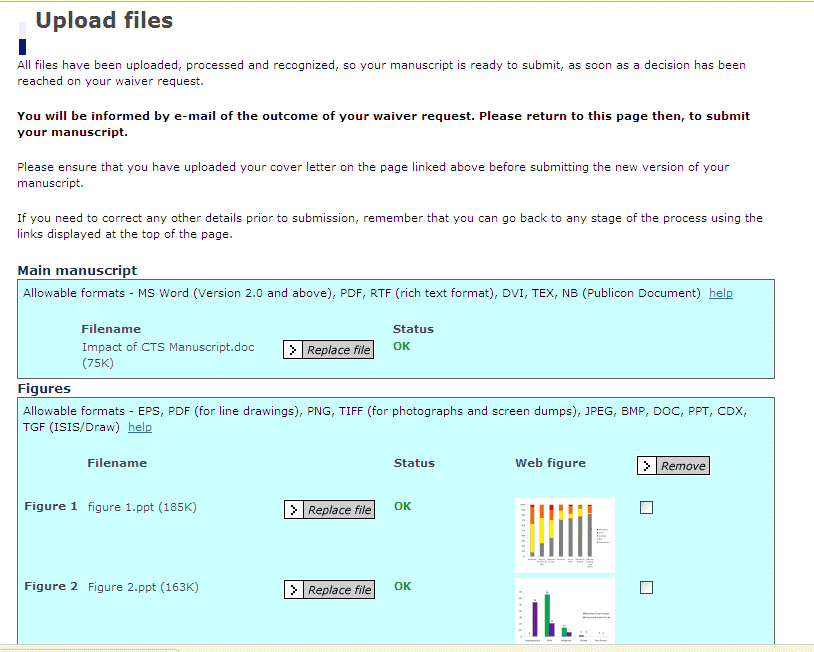
Finally submitted my very own manuscript

Yeay!After all the hard work,I'm just relieved~~~ Our group had to do 4 manuscript. Matun is in-charge of the main manuscript, Prisca, Micheal and me had to create 3 whole new manuscript to submit to 3 different journals. So yup, that's one manuscript per-person! It took quite an enormous deal of time, money, stress, tears, laughter and joy too. So I don't care anymore whether they will accept it or not, what matter most is the experience! :D


Living proof of my submitted manuscript..hehe..

Sunday, June 26, 2011

Are you Ready for Ramadhan?


I'm asking myself whether i'm ready or not for this holy month of Ramadhan. I'm doing surgery during Ramadhan, which is good, since I heard surgery is not that heavy. I hope I have enough time to spend for Ramadhan. At the same time, i'm also worry, about the state of my spiritual strenght. True enough, 5th year was even more challenging than I thought.


However, my life is not about being a doctor. Of course I want to be the best kind of doctor I can be, but what would that mean if can’t be the best of a muslim that I can be at the same time. If I have to choose to excel in medic or to excel in being a muslim I choose the later. Before this I always thought we should not choose over both since being a muslim you have to be good at both, but the truth is, medic is hard. I never thought I said it. Yes it’s true, and I am admitting it now. So for those reading this, if you are not in medicine and are thinking about doing it, make sure you have a stomach to hold for all the nauseating hardship.

But for now, I am focusing on strengthening my spiritual strength. Without it, I cant be sure I can improve my knowledge in any aspect of my life. So get ready, Rejab, Syaaban and comes Ramadhan, I hope to improve myself to become a better person.

Monday, April 11, 2011

How to Begin and Finish your SST notes

Assalamualaikum... To all my friends, here is just some tips if you are not sure how you want to do your notes. This is how i do it. Its simple and fun! At the end of the day, you come out with a note you can feel satisfied with. 

Check it out:


Step 1: Research

Surf the internet for CPG or journals regarding your topic. Our first priority should be the latest Malaysian CPG followed by international CPG, journals, and trusted website. Books are also essential, but usually inadequate. Surfing the net not only ease your process, as you only need to copy, paste and alter some of the words, in addition, some of the information in the internet is presented in a more creative way making it a better choice.

Step 2: Outline

Refer to the previous post on outline of SST notes (http://doctorimanrozali.blogspot.com/2011/03/guideline-for-sst-5th-year.html). Make sure you have gain all the material to fulfill the outline before starting. Add other things that you found during you research to make your notes more interesting and superb!

Step 3: Fulfilling the outline on Microsoft Office Word

Open a new word document, copy paste the outline and start filling in the outline. If you copy paste from journals, make sure to alter the words so that it is short and concise.
  • If you are typing, don’t use too weird short form. If you do, please provide the clues.
  • Some of the information may be in table form and some other information can be in diagram form.
  • Try to do things in point form

click for larger view


Step 4: Converting the notes to boxes

This is a bit tricky.
Open a new Microsoft Powerpoint Presentation, copy your outline (one sub topic at a time) from word document and paste it into powerpoint. Automatically it will be in boxes. Do for all the outline so that all the outline is in small boxes that can be move around.
  • Give your boxes some outline so that you can alter it later
give outline. Use narrow outline is better
  • Do for all your outline. Use small font (for example : Times New Roman size 9)


Step 5: Planning the whole note

Take a piece of paper, and base on your outline, plan how you want the notes to look like:
Take into consideration the size of boxes of information so that you can estimate the space and how many information you can place in one paper.


 Step 6: Rearranging your notes

Now that you know how you want your notes to look like, just rearrange you boxes around. Add arrown and so on to assist your notes. It may be a little bit different than how you planned, just make sure all your outline are present in the notes.


Have some fun rearranging and touch up your notes until you are satisfied with it. Your notes can be in portrait or landscape


Step 7: Submit your notes to the respective email address

I will accept notes submitted in powerpoint form.
  • for IM notes: sst.internalmedicine@gmail.com
  • for O&G notes : sst.obsngyn@gmail.com


 THAT'S ALL FOLKS! HAVE FUN~ ^^

Tuesday, March 15, 2011

Guideline for SST 5th year:

Guideline General untuk semua notes:

Just like in case write up format, please include these:
  1. Definition
  2. Epidemiology
  3. Aetiology
  4. Patophysiology (if applicable)
  5. Risk factors
  6. Symptoms
  7. Signs/physical findings
  8. Differential Diagnosis
  9. Investigations
  10. Managements
  11. Prognosis and Complications
  12. REFERENCES (PLEASE INCLUDE)


FOR REFERENCES:
  • References from the internet is PROHIBITED, unless it is evidenced based and accepted widely
  • Please use references from textbooks and CPGs  as first priority
  • For IM, please don’t use info from Oxford ONLY, include from other trusted source as well


Untuk IM sahaja
Bagi mereka yang dapat tajuk pharmaco, ada guideline tersendiri:
  1. MOA
  2. Side Effects
  3. Complication
  4. Contraindication
  5. Indication


Tajuk-tajuk pharmacology
  • Antihypertensive
  • Medications for asthma
  • Oral hypoglycemic agents and insulin
  • Medications for cardiac failure
  • Medication for acute coronary syndrome
  • Medication for tuberculosis
  • Statin + Fibrate+ Antibiotics + NSAIDs
Format utk notes:
  • Gunakan font Times New Roman
  • Size 9 minimum, 12 maximum (tapi kalau nak guna utk penegasan tajuk boleh lebih dari saiz 12)
  • Gunakan creativity anda utk menghasilkan mind maps
  • Gunakan table
  • Masukkan gambar jika perlu